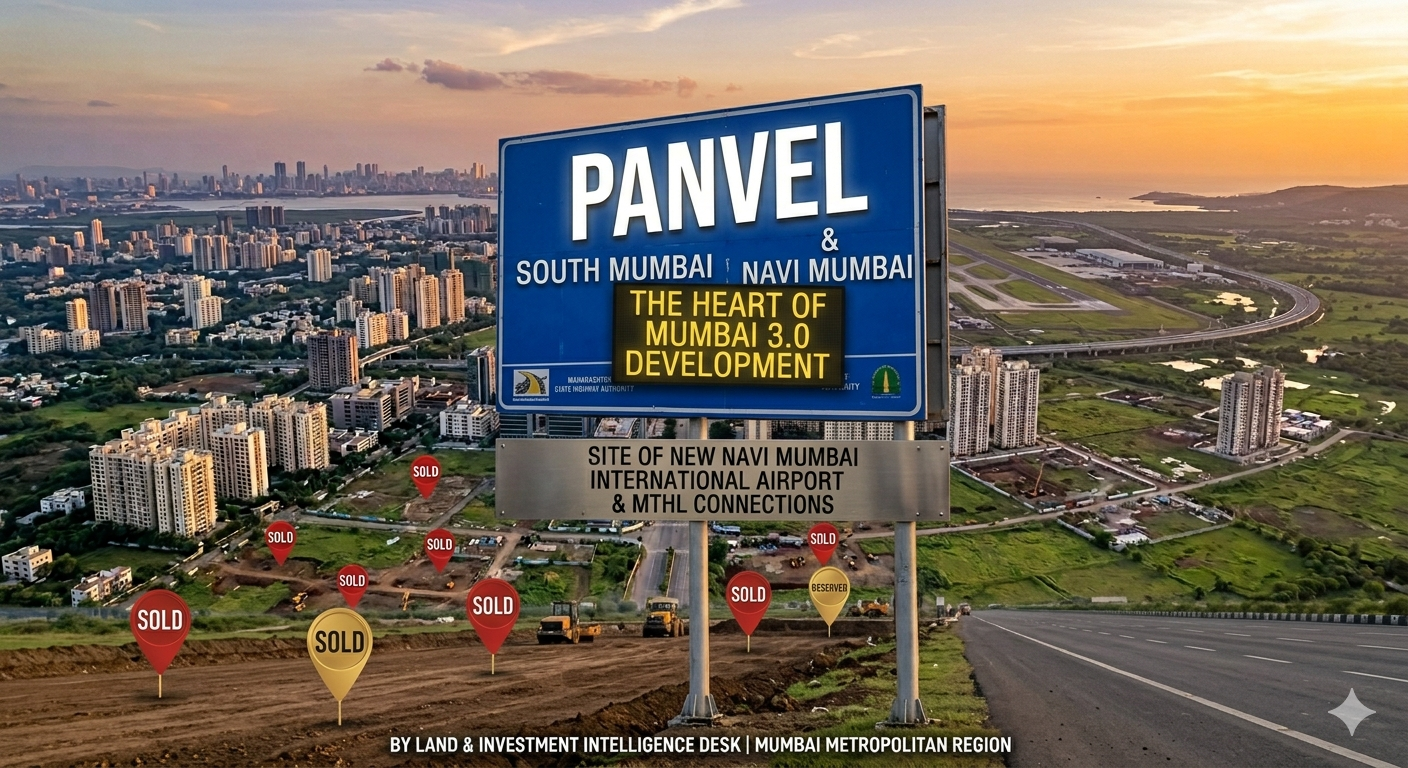
Picture a 300-year-old city where property prices have jumped 110% in just four years, where infrastructure investments exceeding ₹50,000 crore are converging simultaneously, and where the Maharashtra government has announced plans for a "Third Mumbai" three times the size of current Mumbai. This is not a vision statement. This is Panvel — today.
What Exactly Is Mumbai 3.0?
Mumbai has always grown in waves. The original city — today's South Mumbai — was Mumbai 1.0. When that land ran out, planners created Navi Mumbai across the harbour: Mumbai 2.0. Now, with both cities straining at the seams and population density reaching a breaking point, the needle of growth has shifted again — decisively south-east, toward Panvel and the Raigad district.
This is Mumbai 3.0.
The term describes the next urban frontier of the Mumbai Metropolitan Region (MMR): a broad arc of land stretching from Panvel through Ulwe, Dronagiri, Pen, Uran, Neral, and Karjat. Unlike Mumbai's organic, often chaotic sprawl, this expansion is being guided by MMRDA, CIDCO, and the Central Government, with a combined infrastructure commitment that dwarfs anything seen before in a single Indian metro region.
"The futuristic development beyond Panvel is coined as 'Mumbai 3.0' where upcoming infrastructure projects will fabricate seamless connectivity and gravitate economic activities." — Hiranandani Communities, Industry Analysis
At the heart of Mumbai 3.0 is the officially notified Karnala-Sai-Chirner (KSC) New Town — a sprawling 323.44 square kilometre planned city covering 124 villages across the Uran, Panvel, and Pen talukas of Raigad district. On October 15, 2024, the Government of Maharashtra formally appointed MMRDA as the New Town Development Authority (NTDA) for this region, granting it sweeping powers to plan, zone, and develop land.
This is not a proposal in a file. The master plan finalisation is targeted for August 2026. The money is already allocated. The institutions are in place.
Mumbai 3.0 is planned to include:
- A renewable-energy-powered data centre hub
- An education city with leading universities
- A healthcare innovation district
- Global capability centres for multinational corporations
- A new business district at Raigad-Pen modelled on Bandra-Kurla Complex — announced by CM Devendra Fadnavis at Davos
This is not suburbia. This is a full-spectrum city being built from the ground up — with Panvel at its gateway.
By the Numbers: The Scale of What Is Happening
| Metric | Figure |
|---|---|
| KSC New Town Area | 323 sq.km |
| Villages Notified | 124 |
| MMRDA Total Infra Budget (2026–27) | ₹48,073 Crore |
| MMRDA Allocation for KSC New Town | ₹4,000 Crore |
| Price Rise in Panvel (4–5 years) | 110% |
| Panvel Appreciation Post-Airport | 74% |
| MTHL Corridor Premium | 25% |
| South Mumbai to Navi Mumbai via MTHL | 20 Minutes |
| NMIA Phase 1 Capacity | 20 Million Passengers/Year |
| NMIA Full Capacity (by 2032) | 90 Million Passengers/Year |
| Blackstone Investment in Mumbai 3.0 | $5 Billion |
The Airport That Changed Everything
No single project has done more to turbo-charge Panvel's real estate story than the Navi Mumbai International Airport (NMIA) — officially named Loknete D.B. Patil Navi Mumbai International Airport. Its inauguration marks a clear before-and-after moment for every plot of land within a 30 km radius.
Prime Minister Narendra Modi inaugurated the airport on October 8, 2025. Commercial operations began on December 25, 2025, with flights operated by IndiGo, Air India Express, Akasa Air, and Star Air connecting Navi Mumbai to 16 domestic destinations. By February 2026, the airport transitioned to 24-hour, round-the-clock operations with 34 daily departures. International flights commenced in May 2026 with 35 daily international departures.
The airport is a public-private partnership between Mumbai International Airport Limited (MIAL), a subsidiary of Adani Airports Holdings (74% stake), and CIDCO (26%). At full build-out, it will feature four terminals and two parallel runways, with a long-term capacity target of 13.5 crore (135 million) passengers per year — placing it among the world's largest airports.
What the Airport Means for Land Values
History is consistent: every major airport built in India triggers a 10–15 year real estate supercycle in surrounding areas.
- Bengaluru's Kempegowda Airport transformed Devanahalli from farmland into a ₹15,000/sqft premium zone
- Hyderabad's Rajiv Gandhi Airport did the same for Shamshabad and Gachibowli
- Delhi's IGI expansion turned Dwarka and Aerocity into commercial juggernauts
Panvel is now on that same curve — but with one enormous additional advantage: direct sea-bridge access to South Mumbai's financial district in 20 minutes.
How Panvel Is Getting Wired In — Every Direction
The single greatest predictor of real estate appreciation is connectivity. Panvel is receiving an unprecedented simultaneous convergence of air, rail, road, and metro infrastructure. Few locations anywhere in India can claim this density of delivered and planned connectivity.
✈️ Navi Mumbai International Airport — OPERATIONAL (Dec 2025)
Already covered above. The airport is open, flying, and growing. This is the anchor of the entire Mumbai 3.0 story.
🌉 MTHL – Atal Setu — OPERATIONAL (Jan 2024)
India's longest sea bridge at 21.8 km connects Sewri (South Mumbai) to Chirle (Navi Mumbai) in just 20 minutes — reduced from 2 hours. Operational since January 2024, the bridge crossed 80+ lakh vehicles in its first year. Current daily traffic stands at ~22,700 vehicles against a capacity of 70,000, meaning massive headroom remains for growth. Properties within 2 km of the MTHL corridor are already commanding a 25% premium over surrounding areas.
🚇 Navi Mumbai Metro — PHASE 1 OPERATIONAL (Sep 2025)
The first 11.1 km stretch (Belapur–Pendhar) became operational in September 2025 and has fundamentally reset pricing in Upper Kharghar — Sectors 34–40 and Pendhar/Rohinjan now price closer to core Kharghar. Remaining phases are planned to connect to the airport and Taloja Extension.
🚆 Panvel–Karjat Suburban Railway Corridor — UNDER CONSTRUCTION
A 29.6 km suburban rail link expected to be operational by end-2025/2026, cutting CSMT-to-Karjat travel time by approximately 30 minutes and integrating the entire corridor into Mumbai's suburban network. This opens up Karjat, Neral, and surrounding areas to daily Mumbai commuters — massively expanding the affordable housing catchment zone.
🛣️ Virar–Alibaug Multimodal Corridor — PLANNED
A 126 km mega-highway that will connect the northern fringes of the MMR to the southern Raigad coast — with KSC New Town sitting right at its centre. A game-changer for logistics, commercial real estate, and last-mile connectivity.
🚢 JNPT Seaport Expansion — ONGOING
Jawaharlal Nehru Port Trust — already India's largest container port — is expanding. The Panvel-JNPT corridor creates a dual locational advantage: air AND sea connectivity, enabling a global logistics hub with no parallel in the country.
🚄 Delhi–Mumbai Freight Corridor — PLANNED
The dedicated freight corridor terminus in this region will unlock industrial and warehousing demand at a scale rarely seen. Massive employment generation follows infrastructure of this kind — and those workers need homes.
🛤️ Mumbai–Pune Expressway Missing Link — UNDER CONSTRUCTION
An 8-lane underground tunnel — Asia's widest road tunnel — will cut Mumbai-Pune travel by 30 minutes. This boosts cross-investment between two of India's largest tech economies, with Panvel sitting squarely in the middle.
"Few locations in the region offer such a convergence of air, rail, road, and metro infrastructure. Growth in Panvel is being guided by NAINA, which provides a structured framework through zoning regulations and long-term planning." — The Realty Today, December 2025
The Price Appreciation Story — Verified and Documented
Land and property data from the Panvel region tell a story that needs no embellishment. These are verified market movements, driven entirely by infrastructure delivery.
Panvel property prices have risen 110% over four years. Post-airport inauguration, Panvel-specific appreciation stands at 74%. MTHL has triggered 10–30% appreciation across the wider Navi Mumbai corridor. Rental yields are climbing toward the 4.5% mark as the airport scales operations.
Yet despite all this appreciation, current pricing in Panvel ranges from ₹8,000–12,500 per sq.ft. for apartments — still 30–50% below central suburbs like Andheri, Thane, or Bandra. Plot and land values, particularly in NAINA-designated zones and the new KSC New Town footprint, remain at a fraction of their long-term potential.
This gap is the investment thesis in one sentence: the infrastructure has arrived, but prices have not yet fully caught up.
"In Panvel, you're not just buying property — you're investing in the infrastructure transformation that will define Mumbai's next century of growth." — NewProjectsOnline, December 2025
What the Headlines Are Saying — Real News, Real Dates
The Mumbai 3.0 story is thoroughly documented in mainstream media and official government communications. Here is a curated trail of evidence:
Tribune India / ANI (November 18, 2025)
"Navi Mumbai International Airport to Begin Commercial Operations from December 25, 2025"
The official airport operator confirmed PM Modi's inauguration on October 8, 2025, set the stage for a commercial launch with IndiGo, Air India Express, and Akasa Air connecting 16 domestic cities.
Gulf News (December 25, 2025)
"Navi Mumbai International Airport Commences Operations"
India's newest greenfield airport begins commercial service. From February 2026, round-the-clock operations expanding to 34 daily departures.
Travel & Tour World (December 26, 2025)
"Navi Mumbai Airport Begins Operations — A New Era for India Aviation"
NMIA opens with 15 scheduled departures to nine destinations. By end of 2026, the airport aims to accommodate direct services to both domestic and international destinations.
Revaahomes.com (May 2026)
"Mumbai 3.0 Complete Guide: KSC New Town Area-by-Area"
₹4,000 crore allocated in MMRDA's 2026–27 budget for KSC New Town alone. Total infra outlay ₹48,072.5 crore — 87% to infrastructure works. First MMRDA surplus budget in nine years.
The Realty Today (December 12, 2025)
"Mumbai's Next Leap: Why Panvel Is the Launchpad for Mumbai 3.0"
Mumbai 3.0 will include a renewable-energy-powered data centre hub, an education city with leading universities, a healthcare innovation district, and global capability centres.
Niranjan Hiranandani / Industry Report
"Mumbai 3.0: Why Now Is the Time to Invest in Panvel"
Areas well-connected and infrastructure-backed in cities like Mumbai typically witness double-digit growth, and Panvel is projected to follow this trend as infrastructure nears completion.
Housivity (January 2026)
"Navi Mumbai International Airport Opens: Property Prices Surge Across Panvel, Ulwe & Kharghar"
Property prices in Panvel already up by 74% — the region has transitioned from a future promise to a present reality.
NoBrokerage Blog (February 2026)
"MMRDA's ₹4,000 Crore Investment in Karnala-Sai-Chirner: A Deep Dive into Third Mumbai"
MMRDA plans to raise funds through land monetisation. Around ₹11,177 crore expected from land assets as KSC Town emerges as an independent economic hub.
Hiranandani Communities (Industry Report)
"Empowering Mumbai's Future: The Panvel-Karjat Corridor Driving Mumbai 3.0"
The mega projects including NMIA, MTHL, Delhi-Mumbai Freight Corridor, and Virar-Alibaug multimodal corridor will be game changers in shaping the new live-live centres of Navi Mumbai.
The Infrastructure Delivery Timeline
Understanding where Mumbai 3.0 stands on its delivery curve is critical. The best time to invest in any infrastructure-led growth story is before all projects are delivered — when prices still reflect uncertainty rather than confirmed value.
Land Opportunities Across Every Budget
We have curated a portfolio of land and plot opportunities across the Panvel–Raigad corridor, spanning multiple price points and use cases. Whether you are a first-time investor, a developer, or an NRI seeking long-term appreciation — here is the current opportunity landscape:
| Micro-Market | Plot Type | Starting From | Key Advantage | Stage |
|---|---|---|---|---|
| Panvel City Core | Residential / Commercial | ₹45 Lakh | Railway junction + MTHL access + Airport | 🔥 Hot |
| Ulwe | Residential Plots | ₹55 Lakh | Airport doorstep, MTHL terminus zone | 🔥 Hot |
| Dronagiri | Industrial / Logistics | ₹30 Lakh | JNPT expansion zone, freight advantage | ↑ Rising |
| Pen (Raigad) | Agricultural / Mixed | ₹18 Lakh | KSC New Town core, master plan upside | ★ Emerging |
| Uran | Residential / Commercial | ₹38 Lakh | MTHL landing zone, Dronagiri Node | ↑ Rising |
| Kharghar (Upper Sectors) | Residential Plots | ₹80 Lakh | Metro operational, greenfield, green belt | 🔥 Hot |
| Taloja / Kamothe | Industrial + Residential | ₹25 Lakh | Industrial node + metro planned extension | ↑ Rising |
| Karnala / Sai / Chirner | Land Parcels / Plots | ₹12 Lakh | Core of KSC New Town — pre-master-plan pricing | ★ Emerging |
| Neral / Karjat | Weekend Homes / Land | ₹8 Lakh | Suburban rail link, hills, long-run upside | ★ Emerging |
All plots are title-verified, RERA-compliant where applicable, and available for site visits. Prices are indicative as of June 2026.
10 Reasons to Invest in Panvel — Right Now
1. The Airport Is No Longer a Promise
NMIA is open, flying, and carrying 22,000+ passengers daily. Every historical precedent shows airport-proximate land doubles or triples within a decade of operations commencing. The speculation premium is behind us. The execution premium starts now.
2. South Mumbai Is 20 Minutes Away
The MTHL has permanently collapsed the psychological and physical distance between Panvel and South Mumbai's financial districts. This is the same dynamic that made Bandra valuable when the Bandra-Worli Sea Link opened — but at a fraction of the price.
3. Prices Are Still 30–50% Below Central Suburbs
Despite 110% appreciation in four years, Panvel remains dramatically underpriced compared to Andheri, Thane, or Kharghar core areas. The infrastructure is here. The price catch-up is the trade.
4. ₹48,000 Crore of Irreversible Government Commitment
MMRDA's record 2026–27 budget — its first surplus budget in nine years — with ₹4,000 crore dedicated to KSC New Town alone, leaves no doubt about political will or long-term commitment.
5. A Planned City — Not Another Sprawl
Growth is guided by NAINA zoning and the KSC master plan. Residential areas, commercial districts, tech parks, and open spaces are being thoughtfully integrated. You are investing in the equivalent of Navi Mumbai's original planning precision — before it became expensive.
6. Equidistant Between Mumbai AND Pune
Panvel sits between two of India's largest IT economies. The Mumbai-Pune Expressway Missing Link cuts travel further, and the corridor is emerging as a business district that serves both cities — doubling the commercial demand catchment.
7. The Blackstone Signal
The world's largest alternative investment manager has committed $5 billion specifically to Mumbai 3.0. Institutional capital of this scale moves only when the risk-reward is asymmetrically favourable. Individual investors rarely get to co-invest alongside Blackstone at the same price point.
8. JNPT + Airport = India's Only Air-Sea Logistics Hub
India's largest seaport and one of its newest international airports, connected by a dedicated freight corridor — this combination creates industrial, warehousing, and cold-chain logistics demand that will generate hundreds of thousands of jobs and years of housing demand.
9. The Master Plan Window Is Closing
Once MMRDA finalises the KSC master plan (target: August 2026) and permitted land use is locked in, prices will permanently reprice. Every day that passes is a day closer to that repricing event. Pre-master-plan land in Karnala, Sai, Chirner, and Pen is among the last genuinely early-stage land available in the MMR.
10. We Have Opportunities Across Every Budget
Whether you have ₹8 lakhs for a plot in Neral or ₹5 crore for a commercial parcel in Ulwe — we have vetted, title-clear, investment-grade land parcels across the entire Mumbai 3.0 corridor. These are not brochures. These are registered, site-ready opportunities with transparent pricing and legal clarity.
The Bottom Line
Mumbai did not become India's financial capital by accident. It became one because, at every critical moment in its history, someone had the vision — and the courage — to invest in land that others had not yet fully valued.
In 1960, Navi Mumbai was creeks and mangroves. Today, a flat in Vashi costs ₹1.5 crore. In 2000, Kharghar was scrubland. Today, sector-facing plots change hands at ₹2 crore and above.
The Panvel region in 2026 is at exactly that inflection point. The infrastructure that will drive the next 25 years of value creation is either delivered or irreversibly committed. The master plan is weeks from finalisation. The airport is flying international routes. The sea bridge is open. The government has put ₹48,073 crore on the table.
The Third Mumbai is rising. The question is simply: will you rise with it?
Contact us to explore our full portfolio of land opportunities in the Panvel–Raigad corridor. Site visits available across all micro-markets. All plots title-verified. Prices start from ₹8 Lakh.
Sources & References
- Tribune India / ANI — "Navi Mumbai International Airport to Begin Commercial Operations from December 25, 2025" — November 18, 2025
- Gulf News — "Navi Mumbai International Airport Commences Operations" — December 25, 2025
- Travel & Tour World — "Navi Mumbai Airport Begins Operations, Marking a New Era for Aviation in India" — December 26, 2025
- Revaahomes.com — "Mumbai 3.0 Complete Guide: KSC New Town Area-by-Area" — May 2026
- The Realty Today — "Mumbai's Next Leap: Why Panvel Is the Launchpad for Mumbai 3.0" — December 12, 2025
- Niranjan Hiranandani — "Mumbai 3.0: Why Now Is the Time to Invest in Panvel" — November 2024
- Housivity — "Navi Mumbai International Airport Opens: Property Prices Surge Across Panvel, Ulwe & Kharghar" — January 2026
- NoBrokerage Blog — "MMRDA's ₹4,000 Crore Investment in Karnala-Sai-Chirner Town" — February 2026
- Hiranandani Communities — "Empowering Mumbai's Future: The Panvel-Karjat Corridor Driving Mumbai 3.0"
- NewProjectsOnline — "Panvel 2025 Infrastructure Masterplan" — December 13, 2025
- MMRDA Official — Karnala-Sai-Chirner New Town Notification — October 15, 2024
- BlackRidge Research — "Navi Mumbai International Airport: Inauguration Updates 2026" — February 2026
- Housivity — "MTHL Impact on Navi Mumbai Property Prices" — 2025
- PuneNow — "Maharashtra Government Notifies Mumbai 3.0: Full Map and GR" — March 2026
— Dr. Avinash Jagdale
Managing Director, JPrime Group

