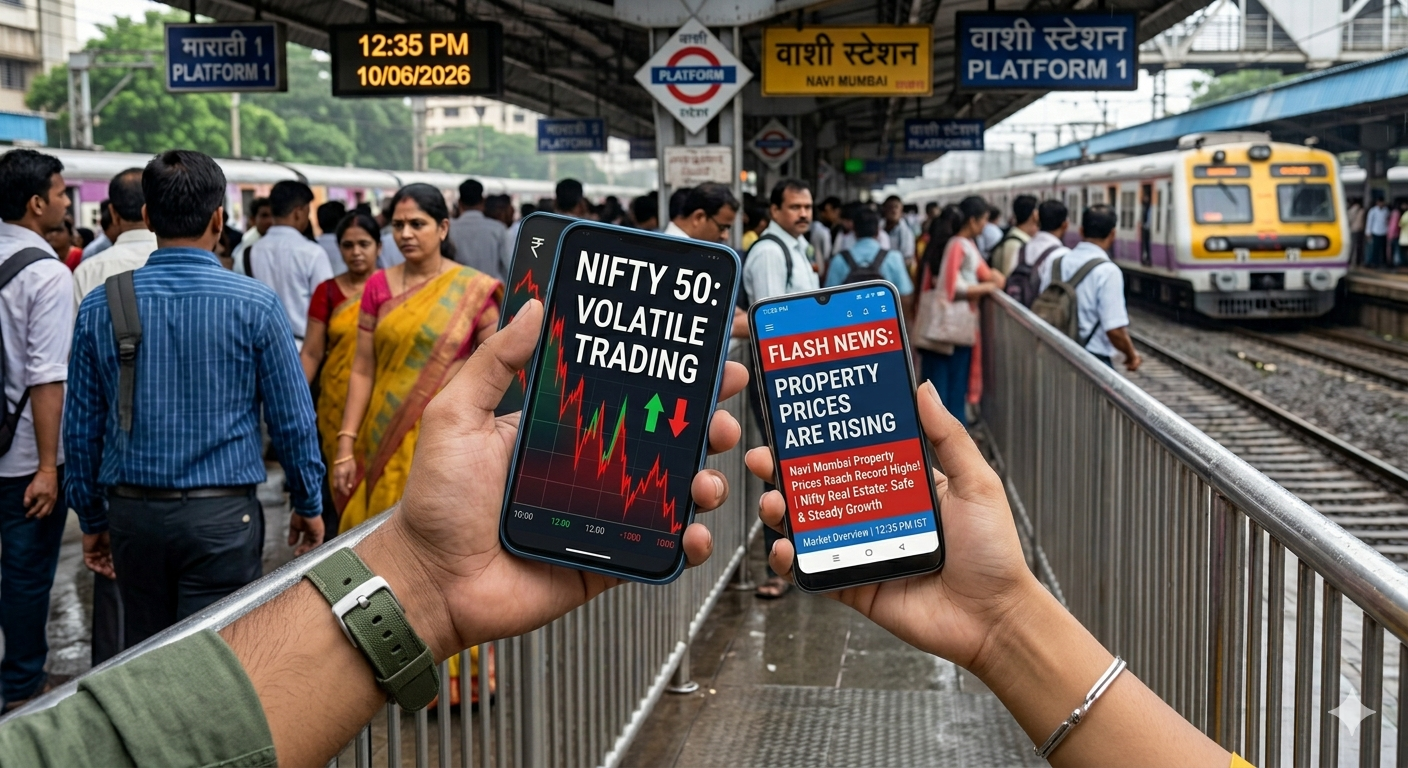
Let me be honest with you for a moment.
Every few months, someone posts a chart showing how the Nifty 50 has delivered 12% CAGR over 20 years — and technically, they are not wrong. Then someone else shares a story about turning ₹5 lakh into ₹50 lakh through options trading — and somewhere behind that story is a version they are not telling you.
The real question for most Indian families — whether you are in Navi Mumbai, Pune, Bengaluru, or any other city — is not which asset class sounds the best at a dinner table. It is: if I put my savings here, what is the actual chance it grows, and what is the actual chance it does not?
In 2026, we finally have enough data to answer that honestly. And the picture is quite different from what most financial influencers will tell you.
Let's Start With the Stock Market — The Full Picture
The Indian stock market has been on a remarkable run. The Nifty 50 and Sensex delivered approximately 10.5% and 9.1% gains in 2025, their tenth straight year of annual gains. For long-term investors who stayed patient through every dip, that is genuinely good news.
But here is what that headline number does not show you.
Between October 2024 and March 2025, Foreign Institutional Investors (FIIs) pulled out roughly $28 billion from Indian equities. That one move sent the Nifty 50 down 13% from its September 2024 peak. And this was not a one-month blip — official NSDL data confirmed that 2025 became the worst year on record for foreign investment in Indian equity markets, with FIIs selling shares worth over ₹1,59,779 crore across the year.
When that selling happens, it is not the institutional investors who feel the pain first. It is the retail investor watching their portfolio on a phone screen, trying to decide whether to hold or cut losses.
The World Bank tracks India's stock price volatility using 360-day rolling data. The number reflects what seasoned market participants already know: sharp, sudden swings are not rare events in Indian equities. They are structural features of the market.
Sources: Upstox / NSDL — fii-outflows-2025 · World Bank / Trading Economics — india-stock-volatility
The F&O Situation — Numbers Confirmed in Parliament
Now let us talk about futures and options trading, because this is where millions of young Indians have placed real money in recent years.
In December 2025, the Government of India confirmed in the Lok Sabha that individual traders lost a net ₹1,05,603 crore in the F&O (futures and options) segment during FY2024-25. Not a section of traders. Not the unlucky ones. Nearly 90% of all individual participants ended the financial year with losses.
SEBI's response was telling: they mandated that every trading platform must now display a warning at login that nine out of ten individual traders incurred losses in the equity derivatives segment. This is not a disclaimer buried in fine print anymore. It is a government-mandated front-page warning.
Think about that for a second. The regulator of India's financial markets felt the situation warranted the equivalent of a cigarette packet health warning on trading apps.
Source: Moneylife / Parliament of India — ₹1.06 lakh crore lost by F&O traders
What About SIPs and Mutual Funds?
Here is where the conversation gets more nuanced — because SIPs and mutual funds genuinely are a better path for most equity investors than direct trading or F&O.
Domestic mutual funds have seen consistent SIP inflows even through the worst FII selling periods of 2025. For someone with a 10–15 year horizon and the emotional discipline to ignore short-term NAV drops, a well-chosen mutual fund has delivered and will likely continue to deliver reasonable real returns.
But here is the part people underestimate: the psychological cost.
During the early 2025 FII-driven correction, even well-managed mutual fund portfolios saw significant NAV declines. Business Standard analysts pointed to "valuation and volatility risks" entering 2025 — with concerns about weak corporate earnings growth, a rupee under pressure, and global capital gravitating toward US markets. Most people intellectually understand that markets recover. Most people also quietly consider redeeming when they see a 15–20% drawdown on their phone screen. The gap between knowing the right thing and doing the right thing is where wealth gets destroyed.
Mutual funds work. But they work best for people who can genuinely leave the money untouched for years — and statistically, most retail investors cannot.
Source: Business Standard — valuation-volatility-risks-2025
Fixed Deposits and PPF — The Honest Trade-Off
Nobody loses money in a bank FD. That is genuinely true and genuinely valuable — the predictability of knowing exactly what your money will become is something no equity product can offer.
But there is a quiet cost. With inflation running at 4–6% and FD rates sitting at 6.5–7%, the real return after tax is marginal at best. Over 10 years, a fixed deposit preserves your capital — it does not build significant wealth. Government schemes like PPF, SCSS, and SSY offer better tax efficiency and similar stability, and they make excellent sense as a foundation for financial security.
The honest conclusion: these are emergency buffers and retirement safety nets. They are not how you build wealth from ₹10 lakh to ₹50 lakh over a decade.
Source: Whalesbook / Investment Analysis — investment-truth-2025
So What Was Happening in Real Estate During All of This?
While equity markets were absorbing ₹1.59 lakh crore in FII outflows, while SEBI was putting health warnings on trading apps, while mutual fund portfolios were swinging through double-digit corrections — the Indian property market was doing something else entirely.
It was rising. Steadily, consistently, across cities.
The Reserve Bank of India's All India House Price Index — compiled every quarter from transaction data across 18 major Indian cities — recorded a 4.2% increase in housing prices during Q4 FY2025-26. That is higher than the 3.8% recorded in the same quarter the year before. The index is not built on projections or developer claims. It is built on actual registered sale transactions.
Source: RBI / DevDiscourse — RBI House Price Index Q4 FY26
At a city level, the numbers are even more striking. Delhi-NCR recorded 18% year-on-year price appreciation. Bengaluru was at 13%. According to Knight Frank's Global House Price Index, India's residential prices grew 7.7% annually — outperforming the United States, the United Kingdom, and Australia. Even quarter-on-quarter, prices climbed 2.9% — sustained growth against a backdrop of global economic headwinds.
Source: Business Standard / Knight Frank — India home prices 7.7% annually
Why Property Doesn't Fall the Way Stocks Do
This is the structural question, and it matters.
Real estate is not connected to global capital flows in the way equities are. When FIIs exit Indian stocks, they liquidate at the click of a button — and 130 million registered retail investors absorb the price impact. That cannot happen with land or apartments. A foreign fund cannot sell a building in Kharghar on a Tuesday because the US Fed signalled a rate hike.
Property price is driven by local, tangible demand: how many families need homes in that city, what is the employment growth in that corridor, what infrastructure is arriving in the next five years. These factors move slowly and predictably — which is exactly what makes real estate a different kind of asset from equities.
Approximately 77% of Indian household wealth is held in property. This is not inertia or cultural habit — it reflects generations of rational observation about which assets hold value through economic cycles, political transitions, and global shocks.
Source: Kalpataru Investment Guide 2026 — reasons-to-invest-2026
There is also something to be said for an asset you cannot panic-sell at 2 AM. The illiquidity of real estate — so often cited as a drawback — is one of its quiet protections. It forces the patience that most investors know they should have but cannot always maintain.
What About the Old Risks in Real Estate — Delayed Projects, Diverted Funds?
This is a fair and important question. Real estate in India had genuine problems for decades: builders who took buyer money and diverted it to other projects, possession delays running five to ten years, layouts changed without consent.
That landscape has been transformed — structurally, legally, and permanently.
RERA — the Real Estate Regulatory Authority — introduced in 2016, has now matured into RERA 2.0 in 2026. The changes are concrete and enforceable.
The Three-Bank-Account System
Makes fund diversion structurally impossible. Your payment goes into a Collection Account first. From there, 70% is automatically moved into a locked Separate Account that can only be used for the specific building you have bought into — not for land acquisition elsewhere, not for a different project. This is not a voluntary practice. It is law, monitored digitally.
Monthly Progress Reporting
Every project must post monthly progress reports with verified photographs on the state RERA portal. A QR code on every advertisement now links directly to this live dashboard — with digital signatures from the project's architect, engineer, and accountant.
Mandatory Dispute Resolution
Dispute resolution — which once meant years in courts — now has a mandatory 60 to 90 day resolution timeline for most complaints.
By mid-2025, nearly 1.5 lakh projects and 1 lakh agents were registered under RERA, and 1.5 lakh consumer complaints had been successfully resolved. Maharashtra's MahaRERA alone has surpassed 50,000 registered projects — approximately 35% of all RERA registrations in India — and the state is widely regarded as the most mature implementation model.
Private equity investors noticed. Institutional PE inflows into Indian real estate surged to $26 billion between 2017 and 2020 — significantly higher than the $17.5 billion in the preceding six years — as global institutional money recognised the improved regulatory framework as a genuine risk reduction.
Sources: Dhanbhumi / RERA 2.0 — RERA 2.0 Guide 2026 · Business Standard — RERA Reshapes Housing · RealEstateGurugram — RERA Buyer Protection
What Does 2026 Actually Look Like for Property?
The macro environment in 2026 is supportive of real estate investment in a way that is difficult to ignore.
The RBI delivered over 100 basis points of rate cuts through 2025, meaningfully reducing home loan EMIs. Cushman & Wakefield's India Outlook 2026 — one of the most closely watched institutional real estate reports globally — projects continued upward price movement with new launches expected to exceed 300,000 units in the premium segment alone. Mid-segment buyers, who had stepped back during the high-rate environment, are actively returning to the market.
Source: Cushman & Wakefield — India Outlook 2026
Whalesbook's year-end 2025 investment analysis noted that the real estate sector entered 2026 with renewed momentum, with nearly 70% of developers anticipating housing price increases of over 5% and commercial real estate leasing exceeding 50 million square feet across the first nine months of 2025.
Source: Whalesbook — Shocking Truth 2025
The long-term numbers are also worth sitting with. Industry bodies CREDAI and Colliers estimate the Indian real estate market — today valued at approximately USD 500 billion — will grow to USD 5 to 7 trillion by 2047. That is not a niche prediction from a bullish developer. It is the consensus view of institutional researchers tracking urbanisation data: 600 million Indians are projected to live in cities by 2026, and that number keeps rising.
Source: Business Standard / CREDAI-Colliers — CREDAI Colliers India Real Estate 2047
A Final, Honest Note
No investment is risk-free — and real estate is no exception. Liquidity is genuinely limited. Location makes an enormous difference to returns. Transaction costs exist. Buying the wrong property in the wrong location will not deliver the returns described in any article.
These are real considerations and worth thinking through carefully before any investment decision.
But look at the complete picture that 2025 and early 2026 have painted:
The government's own Parliament sessions confirmed ₹1.05 lakh crore in retail F&O losses and mandated health warnings on trading apps. NSDL data confirmed record FII outflows from equities. Fixed income returns, after inflation and tax, leave most investors running in place.
Against that backdrop, the RBI's own House Price Index shows sustained property price growth. RERA 2.0 has put legally mandated financial bodyguards on every buyer's investment. Global institutional firms are projecting continued residential demand from an urbanising population of 1.4 billion people.
Equity markets are genuinely rewarding for the patient, the informed, and the financially secure — people who can watch their portfolio drop 15% and feel nothing. For everyone else — the people making real financial decisions with real family money — the case for property as a primary wealth-building asset in India has never been better supported by independent, government-sourced data.
No one needs to sell you that. The data does it on its own.
Key Takeaways for Indian Investors in 2026
- 90% of F&O traders lost money in FY2024-25 — confirmed by SEBI data in Parliament
- FII outflows of ₹1,59,779 crore made 2025 the worst year for foreign equity investment in India (NSDL)
- The RBI's All India House Price Index showed 4.2% growth in Q4 FY2025-26 — consistently rising
- India's residential prices grew 7.7% annually — beating the US, UK, and Australia (Knight Frank)
- RERA 2.0 now legally locks 70% of buyer funds in project-specific escrow accounts
- 1.5 lakh RERA complaints successfully resolved by mid-2025 (Business Standard)
- Indian real estate market projected to grow from USD 500 billion today to USD 5–7 trillion by 2047
All data sourced from: Reserve Bank of India (RBI), SEBI, Parliament of India, NSDL, World Bank, Business Standard, Moneylife, Knight Frank, Cushman & Wakefield, Colliers India, Whalesbook, MahaRERA.
This article is for informational purposes only. Please consult a registered financial advisor before making investment decisions.
— Dr. Avinash Jagdale
Managing Director, JPrime Group