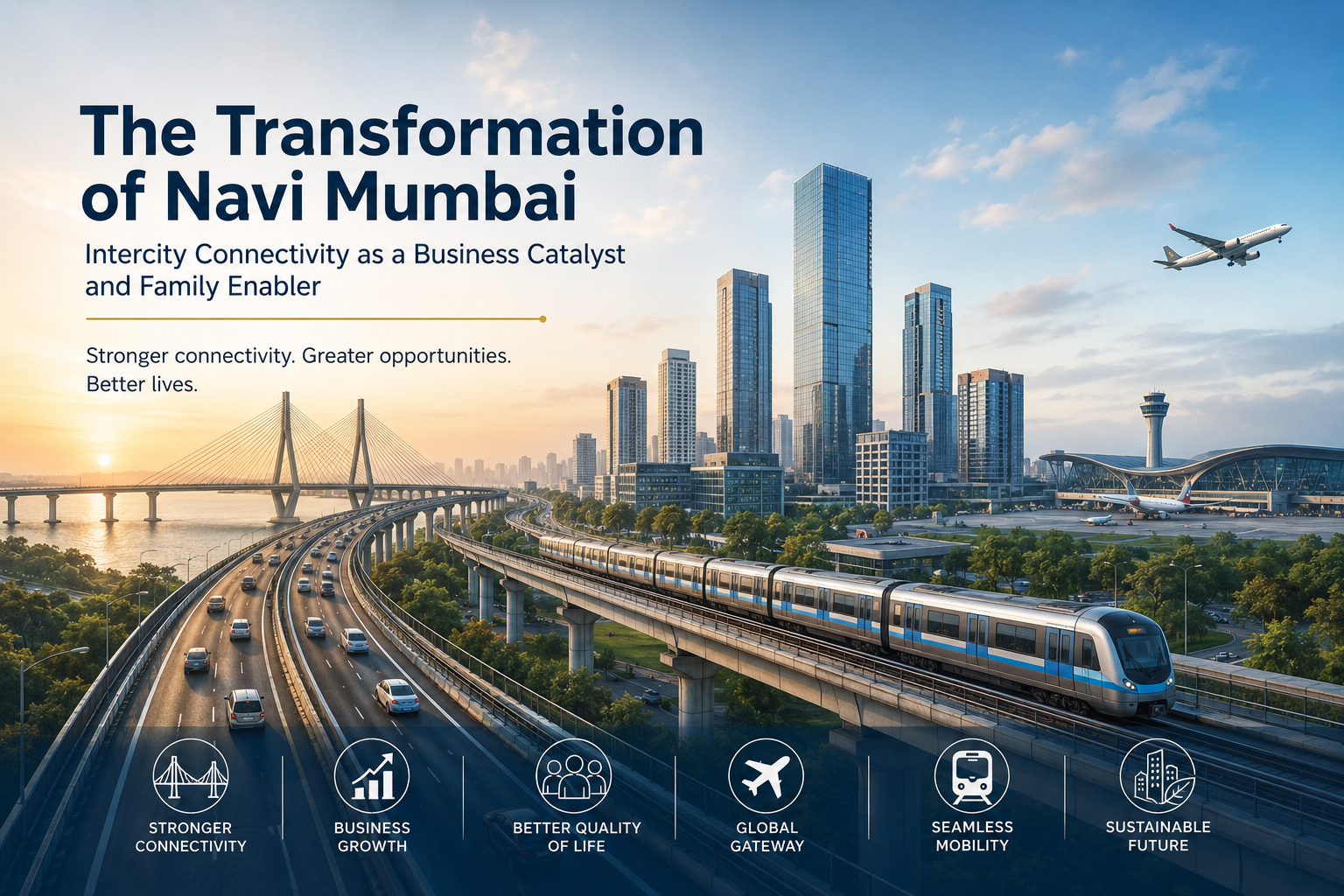
Navi Mumbai is no longer just a planned extension of Mumbai—it’s becoming a destination in its own right.
What was once designed to ease Mumbai’s congestion has now evolved into one of the most important growth engines of the entire Mumbai Metropolitan Region. And if you look closely, this transformation isn’t just about roads, metros, or large-scale projects—it’s about how people experience their daily lives.
From where I stand as a developer—and more importantly, as someone observing how families and businesses evolve—connectivity in Navi Mumbai has taken on a much bigger role. It’s no longer just about getting from point A to B. It’s about enabling opportunities and improving quality of life.
A New Map of Opportunity
The moment the Mumbai Trans Harbour Link (Atal Setu) became operational, something shifted.
Places like Ulwe, Panvel, and Dronagiri suddenly felt closer—not just in distance, but in mindset. What earlier seemed “far” is now part of everyday possibility.
Add to this the expanding metro network and new infrastructure approvals, and you start to see a bigger picture forming—a city that’s no longer growing in pockets, but as one connected system.
Navi Mumbai is quietly moving from being called a “satellite city” to becoming a central node in a much larger, multi-nodal megacity.
Why Connectivity Is Driving Business Growth
In business, time isn’t just money—it’s everything.
And today, Navi Mumbai offers something unique: speed, access, and future readiness.
With strong road networks like Atal Setu, upcoming metro connectivity, proximity to the new international airport, and access to major logistics hubs like JNPT, the region is becoming extremely attractive for businesses.
We’re already seeing the impact:
- Logistics and warehousing hubs are expanding rapidly across the Raigad corridor.
- IT and fintech companies are exploring beyond traditional Mumbai zones, seeking better quality of life for their workforce.
- Large townships and mixed-use developments are gaining traction as live-work-play environments.
This isn’t accidental. Businesses are no longer clustering in one place—they’re spreading out, but staying connected.
The Real Impact: Family Life
While we often talk about infrastructure in terms of investment and growth, its biggest impact is actually at home.
Shorter commutes mean getting back home earlier. It means being there for dinner, for conversations, for small everyday moments that matter.
Better connectivity also means families don’t have to compromise as much anymore. You don’t have to choose between living in a good home and being close to work.
You can have both. And that’s a big shift.
The Airport That Changes Everything
The Navi Mumbai International Airport (NMIA) is more than just a project—it’s a turning point.
It will open the region to global connectivity, attract businesses, boost hospitality and retail, and create entirely new economic zones around it.
If you look at global cities, airports often become the center of growth. Navi Mumbai is heading in the same direction.
Moving Towards a Truly Connected Region
What’s exciting right now isn’t just one project—it’s how everything is coming together.
Metro lines, expressways, coastal roads, and bus systems are slowly integrating into a single network.
The goal is simple: a city where moving between different modes of transport feels seamless.
Because in the end, the real question is—will Navi Mumbai just remain an extension of Mumbai? Or will it become a self-sustaining, world-class urban center?
Right now, the answer seems clear.
What Comes Next
The next phase isn’t just about building more. It’s about improving experience.
- Can people commute without stress?
- Can work and home be within a comfortable distance?
- Can growth happen without compromising livability?
These are the questions that will define the future. And Navi Mumbai seems to be moving in the right direction.
Final Thought
For me, this transformation is not just about real estate or infrastructure. It’s about people.
When connectivity improves, opportunities grow. When opportunities grow, lives change. And when that happens, cities don’t just expand—they evolve.
Navi Mumbai is not just developing. It’s becoming a place where ambition and quality of life can finally exist together.
— Dr. Avinash Jagdale
Managing Director, JPrime Group