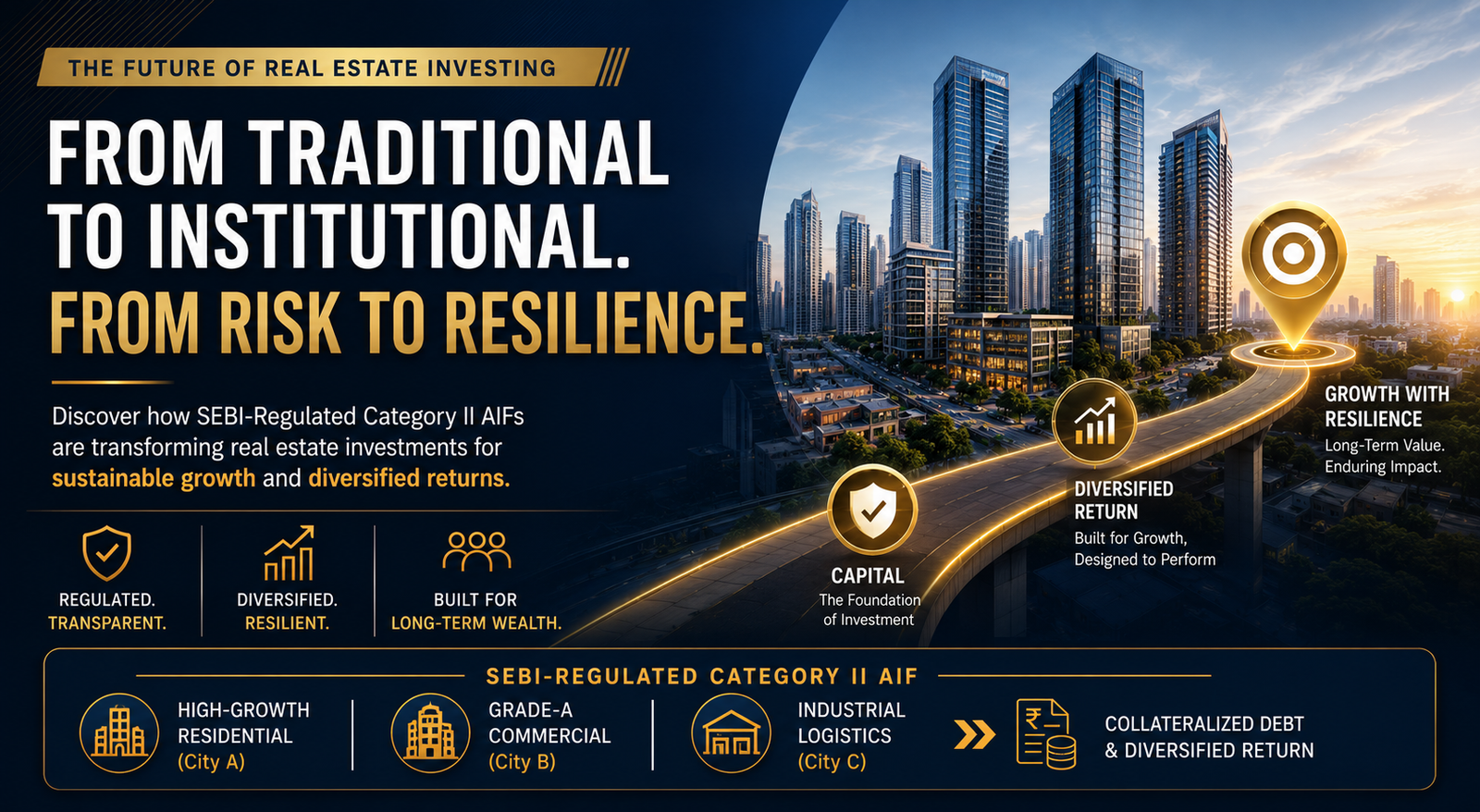
For high-net-worth individuals (HNIs), the paradigm of investing in real estate has evolved beyond buying standalone apartments or managing scattered commercial plots.
While direct property ownership remains a bedrock for generational wealth, it presents distinct scale challenges: lack of operational diversification, massive transaction friction, structural illiquidity, and direct exposure to construction and approval bottlenecks. To navigate these inefficiencies, sophisticated investors have increasingly abandoned traditional, highly physical property ownership frameworks in favor of Real Estate Alternative Investment Funds (AIFs) .
An AIF acts as a institutional private equity pipeline. It pools capital from qualified private individuals to execute large-scale, high-alpha real estate transactions that remain entirely out of reach for retail execution. However, these pooled structures operate within highly strict regulatory environments, complex tax dynamics, and layered operational frameworks. Maximizing performance requires a rigorous understanding of their inner workings.
The Core Structural Mechanics of a Real Estate AIF
In the Indian regulatory layout, Real Estate AIFs are established as pooling vehicles under SEBI Category II guidelines. Unlike a mutual fund or a public Real Estate Investment Trust (REIT), an AIF does not acquire highly liquid, daily-traded securities. Instead, it deploys capital directly into private special purpose vehicles (SPVs), institutional real estate ventures, or private development corporations.
The operational framework of a Category II Real Estate AIF generally splits into two fundamental investment approaches, each appealing to entirely different portfolio objectives:
1. Debt and Structured Finance Funds (Yield-Oriented)
Structured debt operations function as specialized credit providers to Tier-1 or choice mid-market developers. With traditional banking institutions facing strict regulatory caps on land-acquisition financing and early-stage capital deployment, debt AIFs fill this structural gap. They provide project funding via senior secured non-convertible debentures (NCDs) or structured debt agreements.
For the HNI, this translates into structured, predictable cash flow strategies. These returns are reinforced by extensive downside protection, including project asset hypothecation, escrow mechanisms over receivables, and comprehensive promoter guarantees. These vehicles target consistent, double-digit returns with minimized direct equity volatility.
2. Equity and Capital Growth Funds (Appreciation-Oriented)
Real estate equity AIFs behave like traditional, high-conviction private equity platforms. They typically deploy capital at the inception phase of an asset's lifecycle—including land aggregation, design optimization, and early-stage approval processing. By anchoring project equity before construction commences, the fund absorbs significant early-stage risk in exchange for maximum asset appreciation.
These growth funds realize value by tracking the underlying project's development milestones, selling inventory at optimized market cycles, or exiting via institutional bulk sales. While these structures carry longer cash-lock durations and lack immediate yield profiles, they aim for a higher absolute Internal Rate of Return (IRR).
Comparing Institutional Vehicles: AIFs vs. REITs vs. Fractional Ownership
HNIs frequently conflate AIF structures with other real estate investment formats like public REITs or emerging fractional ownership platforms. While all three provide real estate exposure without direct property management, their structural designs serve entirely different functions within a multi-asset allocation model.
| Parameter | Category II AIF | Public REIT | Fractional Ownership |
|---|---|---|---|
| Minimum Capital | ₹1 Crore mandatory ticket | Highly accessible (~1 share) | Typically ₹10 Lakhs to ₹25 Lakhs |
| Asset Stage | Greenfield, Brownfield & Debt | Minimum 80% rent-yielding assets | Exclusively completed commercial |
| Liquidity Profile | Locked (5–7 year close-ended) | High (Daily exchange traded) | Moderate to Low (Private resale) |
| Target Return Architecture | 14% - 22%+ Target IRR (Growth/Yield) | 6% - 8% Yield + modest capital gains | 8% - 11% Yield + targeted capital gains |
Navigating the Core SEBI Regulatory Framework
The Securities and Exchange Board of India (SEBI) treats AIFs as highly specialized options meant strictly for experienced, well-capitalized market participants. To protect the broader retail ecosystem from long-duration illiquidity and complex capital calls, SEBI mandates explicit guardrails:
- Rigid Investment Thresholds: A single HNI or corporate entity must commit a strict minimum investment threshold of ₹1 Crore into an AIF. For employees, directors, or fund managers of the vehicle, the minimum entry floor is adjusted to ₹25 Lakhs.
- Strict Close-Ended Mandates: Real estate AIFs cannot operate as open-ended mutual fund equivalents. They are structured as close-ended pools with typical lock-ins lasting 5 to 7 years. Extensions are tightly governed, capped at a maximum of two years, and require the formal approval of a two-thirds majority of the fund's investors by value.
- Diversification Safeguards: Under SEBI concentration rules, a Category II fund cannot allocate more than 25% of its total investable capital into a single real estate project or portfolio company. This ensures risk is distributed across multiple distinct corporate developments or geographic layouts.
- The Capital Drawdown Methodology: Investors rarely deposit their entire ₹1 Crore commitment upfront. Instead, the AIF issues structured capital calls or "drawdown notices" over a 2-to-3-year investment window as the fund manager finalizes land acquisitions or hits verified construction milestones.
The Mechanics of Pass-Through Taxation
A crucial factor behind the adoption of Category II AIFs by family offices and ultra-HNIs is their tax pass-through status. Under the Indian Income Tax Act, Category II AIFs are granted a distinct fiscal status designed to eliminate double taxation.
The fund vehicle itself does not pay income tax on investment returns generated from capital gains or underlying project interest payouts. Instead, any income earned by the fund is treated as if it were received directly by the investor. The profits are transferred cleanly to the investor's balance sheet, where they are taxed according to the investor's specific legal status and holding duration:
Business Income Rules
If any portion of the AIF's structural gains is classified by tax authorities as core business income rather than investment returns, the pass-through benefit is voided for that specific stream. The fund house must pay tax on that component at the maximum marginal rate before distributing the net proceeds to investors.
Capital Gains and Interest Income Profiles
For standard investments, returns are passed through to the investor. Interest income from debt instruments is taxed at the individual's specific slab rate. Long-Term Capital Gains (LTCG) and Short-Term Capital Gains (STCG) on unlisted shares or debentures are taxed according to standard statutory timelines and prevailing tax codes. This ensures structural tax efficiency compared to corporate investment pools, which are subject to multi-layered tax exposure before distribution.
Critical Operational Risks and Advanced Mitigation Tactics
The promise of double-digit IRR targets shouldn't cloud the practical realities of private real estate investing. Because these vehicles deploy capital into illiquid, long-cycle real estate developments, investors must evaluate three critical operational risks before signing a contribution agreement:
1. Regulatory and Approval Bottlenecks
Real estate assets face significant exposure to local master-planning changes, zoning adjustments, and environmental clearance delays. If a fund manager deploys equity capital into a project before foundational clearances are secured, investor capital can sit idle for years, severely eroding the fund's net IRR.
Mitigation Strategy: Review the fund's investment prospectus for a strict RERA-first deployment policy. Prioritize managers who allocate capital exclusively to projects that have already secured land titles, municipal approvals, and active RERA registrations. This ensures capital is used for immediate construction rather than prolonged litigation or bureaucratic processing.
2. Concentrated Developer Risk
Some real estate AIFs operate as captive financing arms for a small circle of developers. If the selected developer faces systemic liquidity issues, project delivery delays, or operational defaults across their broader portfolio, the AIF's entire capital pool can become impaired simultaneously.
Mitigation Strategy: Demand an independent, multi-developer asset allocation strategy. The fund's investment committee must operate independently of the developers execution teams. It should feature a diversified portfolio distributed across multiple Tier-1 developers and independent real estate brands across separate geographies.
3. Blind Pool Capital Risks
A typical real estate AIF raises capital as a "blind pool." This means investors commit their financial capital based entirely on the fund's stated strategy and the manager's historical track record, before the specific properties or development assets have been acquired or contracted.
Mitigation Strategy: Evaluate the manager's historical investment discipline, underwriting frameworks, and capital call history. Sophisticated investors should look for funds that offer visibility into a pre-identified pipeline of seed assets before the first drawdown occurs. Alternatively, look for co-investment rights that allow larger HNIs to deploy additional capital directly into specific projects after performing asset-level due diligence.
An Investor's Checklist for Vetting a Real Estate AIF
Before committing to a multi-year ₹1 Crore capital drawdown cycle, family offices and HNIs should run a comprehensive operational audit using this four-part checklist:
- Skin in the Game (Sponsor Commitment): Ensure the fund sponsor or asset management company (AMC) invests a meaningful amount of their own capital alongside investors. SEBI mandates a minimum sponsor investment of 2.5% of the corpus or ₹5 Crores (whichever is lower) for Category II AIFs, but market-leading managers often commit significantly more to align incentives.
- Clarity on Fee Structures and Watermarks: Examine the management fee structure (typically ranging from 1.5% to 2.5% annually) and the hurdle rate (the minimum return the fund must generate before performance fees apply, usually set around 8% to 11% compounded). Ensure the performance fees ("carried interest") utilize a hard watermark with catches calculated only after the full investor capital is returned.
- Historical Track Record Through Cycles: Evaluate how the fund manager's previous vintages performed during macro downturns, liquidity crunches, or real estate corrections. Focus on realized exits and actual capital returned to investors (DPI - Distributions to Paid-In Capital), rather than purely theoretical paper valuations (RVPI - Residual Value to Paid-In Capital).
- Robust Asset Valuation Policies: Ensure the AIF employs independent, SEBI-approved third-party valuers to calculate the fund's Net Asset Value (NAV) at regular intervals. Frequent, transparent valuations prevent unexpected down-rounds at the end of the fund's lifecycle.
Key Takeaways for HNI Portfolios
- Institutional Scale: Real estate AIFs provide a hands-off, diversified channel to capture high-yield private property developments without direct operational burdens.
- High-Entry Frameworks: Under SEBI rules, expect a mandatory ₹1 Crore entry ticket and a structural lock-in period often extending across 5 to 7 years.
- Pass-Through Tax Advantages: Category II allocation ensures zero tax friction at the fund level, cleanly transferring capital gains straight to your tax profile.
- Sponsor Due Diligence: Mitigate structural blind pool risks by vetting the fund house's asset diversification framework and execution history under RERA regimes.
Regulatory Architecture Reference: Securities and Exchange Board of India (Alternative Investment Funds) Regulations. Tax laws are subject to shifting annual finance mandates.
Disclaimer: Alternative investments carry significant structural risks. Consult an independent, SEBI-registered portfolio specialist before making long-term fund commitments.
— Dr. Avinash Jagdale
Managing Director, JPrime Group